
Decision-Centric Orchestration: The Next Competitive Advantage
How Executives Can Turn Decision Intelligence into Faster, Smarter, and More Profitable Customer Services

If you want real leverage from decision intelligence, stop scattering decision logic across your processes.
Too often, organizations embed business rules in different activities inside a business process or case handling flow. Decisions are treated as supporting elements—called from tasks, hidden in gateways, duplicated in scripts, or distributed over multiple process variants.
It works—until it doesn’t.
If your core service depends on consistent, explainable, and optimizable decisions, you need to flip the perspective. Instead of process-centric orchestration with embedded decisions, design a decision-centric orchestration, driven by a coherent integrated decision model.
Let’s explore why this matters—and how to do it.
The Problem: Scattered Decisions in a Core Business Service
Consider a travel insurance company offering a travel claim handling service. During the lifecycle of a claim, multiple decisions must be made:
Eligibility
Does the customer have a valid insurance contract?
Is the contract still active?
Is the affected person covered?
Acceptance
Is the incident covered under the policy?
Are the circumstances within contractual boundaries?
Fraud Assessment
Are there indicators of potential fraud?
Compensation
What is the compensation amount?
What form should the compensation take—money, repair, replacement?
Recovery
Can part of the compensation be recovered from a third party?

A common implementation approach is:
Build separate decision models (DMN) for each of these decisions.
Call them from various tasks in a business process (= BPMN) or case management (= CMMN) model.
Let the process determine sequencing and orchestration.
This seems modular. Clean. Structured.
But it creates three structural problems.
Why Process-Centric Orchestration Fails at Scale
1. You Depend on Process Correctness for Decision Completeness
If decision logic is distributed across multiple process steps, you must trust that:
Every relevant decision is invoked,
In the correct order,
With the correct data,
Every time.
In reality, processes evolve. Variants multiply. Exceptions are added. Gateways become complex. Human tasks introduce variability.
Eventually, the guarantee that “all relevant decision considerations have been evaluated” becomes fragile.
And in regulated industries like insurance, fragile guarantees are unacceptable.
2. Data Evolves — Sequential Logic Breaks
In claim handling, information does not arrive all at once:
Additional documents are submitted.
Fraud signals are triggered later.
Coverage interpretations change.
Third-party liability becomes clear days after the initial report.
If your orchestration is sequential and process-driven, re-evaluating earlier decisions becomes difficult:
Do you loop back?
Do you re-trigger all prior tasks?
Do you duplicate decision calls?
Do you maintain state consistency manually?
You end up encoding decision state management inside the process model—something BPMN or CMMN were never meant to optimize.
3. You Block Straight-Through Processing
Imagine a “happy path” case:
All required data is available upfront.
Coverage is clear.
No fraud indicators.
Compensation can be calculated immediately.
Why force the claim through a long sequence of process steps?
A decision-centric approach would:
Evaluate everything immediately,
Determine that the claim can be accepted and compensated,
Trigger direct payout,
Close the case.
This results in:
Faster resolution,
Lower operational cost,
Higher customer satisfaction.
Process-centric orchestration often prevents this because the process—not the decision model—controls progression.
The Shift: From Supporting Decisions to Decision-Centric Orchestration
The alternative is simple in principle, but powerful in effect:
Build one integrated decision model that governs the end-to-end business service outcome.
Instead of creating separate DMN models for Eligibility, Acceptance, Fraud, Compensation, and Recovery, you create a comprehensive decision model that:
Integrates all decision logic,
Understands dependencies between decisions,
Evaluates based on the complete case data,
Determines the current “decidable state” of the case.
In this architecture:
DMN defines what can be decided.
BPMN/CMMN defines what actions must be performed to obtain missing information.
The orchestration becomes decision-driven.
What an Integrated Decision Model Looks Like
The integrated DMN model would:
Take the complete claim case data as input.
Evaluate:
Eligibility
Coverage
Fraud risk
Compensation calculation
Recovery potential
Produce outputs such as:
Claim Status (Rejected / Pending Info / Accepted)
Required Missing Information
Compensation Amount & Type
Fraud Investigation Required (Yes/No)
Recovery Action Required (Yes/No)
Case Closure Possible (Yes/No)
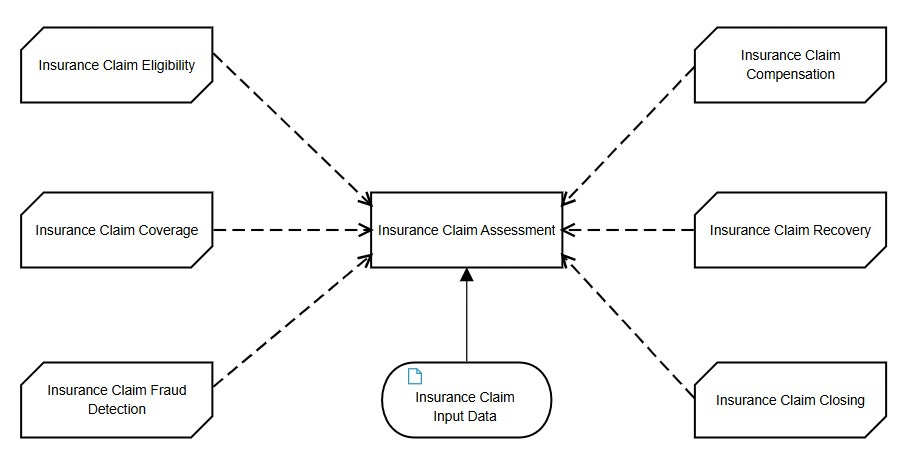
The decision model becomes the single source of truth about the state of the service.
How Decision-Centric Orchestration Works
Step 1: Every Data Change Triggers Re-Evaluation
Whenever:
A document is uploaded,
A fraud score changes,
A contract update is retrieved,
A third-party liability is confirmed,
The integrated DMN model is re-evaluated.
No process loops. No manual state transitions. No “did we already check this?” logic.
The decision model determines:
Can we now close the case?
Do we need more information?
Do we escalate?
Do we compensate?
Step 2: The Process Executes What the Decision Requires
The BPMN or CMMN layer becomes simpler and more generic.
It does not orchestrate decision logic.
Instead, it:
Requests missing information,
Assigns investigations,
Executes payments,
Sends notifications,
Performs recovery actions.
The process becomes reactive to the decision model.
Decision drives process—not the other way around.
Architectural Advantages
1. Consistency Across Channels
Whether a claim is submitted via:
Mobile app,
Web portal,
Partner system,
Call center,
The same integrated decision model evaluates it.
No channel-specific rule drift.
2. Transparency and Explainability
A single DMN model makes it possible to:
Explain why a claim was rejected,
Trace which rule determined compensation,
Audit fraud decisions,
Simulate policy changes.
Scattered rule fragments inside processes make this nearly impossible.
3. Optimization and Simulation
Because decisions are centralized:
You can simulate thousands of cases.
You can optimize compensation policies.
You can tune fraud thresholds.
You can evaluate straight-through processing rates.
This is how decision intelligence becomes strategic—not tactical.
4. True Straight-Through Processing
With integrated evaluation:
If everything is decidable immediately → compensate.
If not → request only what is missing.
When missing data arrives → re-evaluate instantly.
This enables maximum automation while preserving control.
How to Design a Decision-Centric Model
Here’s a practical approach:
1. Model the Final Service Outcome First
Start with the ultimate business question:
Can this claim be closed, and if so, how?
Work backward using DMN decision requirements diagrams (DRDs).
2. Identify All Dependent Decisions
Map:
Eligibility
Coverage
Fraud
Compensation
Recovery
Define their dependencies explicitly in the decision model—not implicitly in the process.
3. Define Clear Decision Outputs
Ensure your integrated model outputs:
Status
Required actions
Required missing data
Monetary results
Risk indicators
This allows the orchestration layer to remain generic and stable.
4. Make the Process Event-Driven
Design BPMN/CMMN models that:
React to decision outputs,
Trigger data collection,
Re-evaluate decisions on every meaningful data change.
The process becomes a facilitator—not a decision coordinator.
The Core Insight
When delivering a core business service, your competitive advantage does not lie in drawing better flowcharts.
It lies in:
Making the right decisions,
At the right time,
With the right data,
In a consistent and explainable way.
That requires decision-centricity.
Not decision support.
Conclusion: Decision Intelligence as the Orchestrator
If you want high leverage from DMN:
Do not distribute decision logic across tasks and processes.
Do not rely on process sequencing to ensure decision completeness.
Do not accept rework-heavy sequential logic.
Instead:
Build one integrated decision model per core business service.
Re-evaluate it at every data evolution.
Let it determine what is decidable and what is required.
Let BPMN/CMMN execute the necessary actions.
That is decision-centric orchestration.
And that is how decision intelligence becomes the brain of your organization—not just a collection of rules hidden in your workflows.